
Flagstone vs Pavers – Choosing Between Flagstone And Pavers In Your Yard
Comparing Flagstone vs Pavers may be tough for homeowners. Each material has its own pros and cons.
Comparing Flagstone vs Pavers may be difficult for homeowners. These two options are great for landscaping projects, but each has its pros and cons. This post aims to compare Flagstone vs Pavers and help you choose the best option for your home. We will take into account the costs, installation, aesthetics, and which one requires less maintenance than the other. Read on to learn more.
Flagstone
What Is Flagstone
Flagstone is a sedimentary stone that naturally splits into layers, making it ideal for areas such as patios, walkways, outdoor living areas, and around the BBQ. Flagstone is a natural stone, unlike pavers, which are generally man-made.
Common Types Of Flagstone
There are 4 common types of Flagstone. Each has its own unique color palette and characteristics.
These are the 4 most common types:
- Sandstone
- Limestone
- Slate
- Quartzite

Cuts And Shapes
Since flagstone is a natural stone, it can come in irregular, random shapes or be cut to size and spec, such as in patterns or shapes such as squares or rectangles.
Flagstone Thickness
Flagstone ranges in thickness. For pedestrian usage, you will need a thickness of 1-1.5 inches. For driveways, you will need more than 2 inches of depth.
Installation
Flagstone installation is time-consuming and requires specialists to install. The stone is heavy. It requires specialist lifting equipment. The irregular shapes, thickness, and structural requirements to manage the installation all pose installation challenges.

Pros Of Flagstone
- Flagstone is a naturally beautiful stone.
- Each stone has a unique character to it.
- The surface is slip-resistant if it isn’t polished.
- Flagstone has a long lifespan, even more so when maintained correctly.
- Flagstone adds value to your property.
- Flagstone blends in well with xeriscape and native landscaping options.
Cons Of Flagstone
- Flagstone is significantly more expensive than paver options.
- The irregular shapes will take longer to install. Labor costs naturally will be higher as a result.
- You may develop a shifting base over time if the flagstone isn’t installed properly. This will require re-installation.
- Flagstone stains easily and requires regular sealing.
- Weed growth can be expected between the joints. This is normally the case though.
Pavers
What are Pavers
Pavers are individual units used to create patios, driveways, walkways, and pool decks. Pavers are modular by design, flexible, and easy to repair because a section can be quickly removed and replaced. Pavers are man-made.
Common Types Of Pavers
There are 4 common types of pavers. Each has its own color options and characteristics, allowing customers to choose what best suits them.
These are the 4 most common types of pavers:
- Concrete Pavers
- Clay Brick Pavers
- Natural Stone Pavers
- Porcelain Pavers
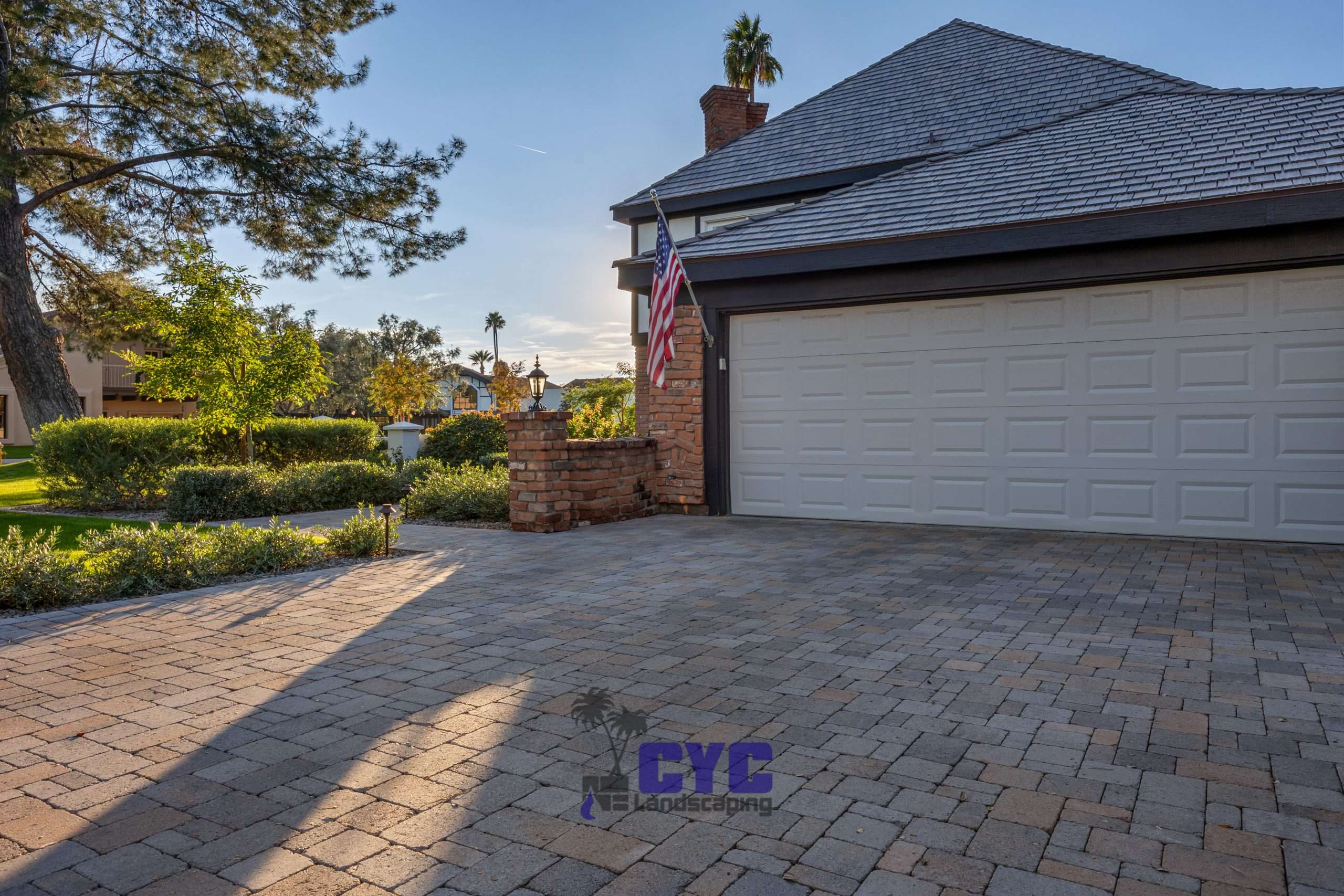
Cuts And Shapes
Pavers come in many cuts and shapes. The cut and shape affect not only the appearance but also the strength, installation speed, pattern options, and the overall style of the design.
Pavers can be narrowed down into the following broad categories:
- Rectangular and square pavers
- Large-format pavers (common in concrete or porcelain pavers)
- Interlocking pavers
- Cobblestone-style pavers
Thickness Of The Pavers
Pavers can range in terms of thickness. For pedestrian use, you may find 1¼” to 2⅜” being sufficiently thick. For vehicle traffic and driveways, you can expect pavers to be in the 2⅜” to 3⅛” range.
Installation
Regardless of the material, most paver systems require the following steps:
You will need to excavate the area. Once excavation has been completed, the landscape contractor will need to lay a compacted, crushed stone base. A layer of sand or mortar is laid on the crushed stone base, to which the pavers are installed. After which, the edges are secured, and the filling joints are filled with polymeric sand. It is a rather straightforward process.

Pros Of Pavers
- High-quality pavers are strong, durable, and can handle heavy vehicle traffic.
- Pavers are less prone to cracking due to the expansion joints. There is less chance of structural cracks.
- Pavers are easy to repair in the event one paver cracks due to their modular design.
- Pavers offer design versatility often not found in other solutions.
Cons Of Pavers
- Pavers are more costly than poured concrete, and Flagstone is considerably more expensive than pavers. Pavers sit between these two price points.
- Installation is labour-intensive due to the excavation and prep.
- Weed growth between the joints will be an ongoing problem.
- Shifting and settling may also arise if the base prep wasn’t perfect.
- Like all the other materials, pavers also need routine maintenance.
Differences Between The Pavers And Flagstone
Choosing between Flagstone and Pavers often depends on your aesthetic preference, budget, and the function of the space. For example, a driveway would need a robust solution as opposed to a walkway. Flagstone is a natural stone with a rustic look that has matched durability. Pavers are man-made, uniform, more affordable, and easier to install and repair.
This is how you decided between the two materials:
Material And Appearance Differences
Flagstone offers a unique look and feel. It has an organic, rustic look that complements your yard with its selection of natural colors. Flagstone can have smooth or natural (unpolished) finishes. The smooth version is slippery when wet. We advise against them.
Pavers offer a uniform look and feel. Offering a wide variety of colors and patterns makes this a great choice for homeowners. It is also a precise offering in the sense that each is the exact size it needs to be.
Price And Cost Differences
The cost of the flagstone material and installation is considerably higher than that of pavers. If you are budget-conscious, a great-looking paver is an excellent option for homeowners. Flagstone is approximately twice the price of pavers.
Best Use Cases Compared
Certain materials are better suited to certain applications. For example, polished/ smooth flagstone won’t be a good idea when it gets wet. Around the pool or outdoors in general won’t be a good idea due to the slippery nature. However, natural Flagstone is a great option for patios, walkways, garden paths, and the homeowner wants a natural look.
Pavers, on the other hand, are great for driveways, patios, pool decks, and walkways. It is versatile and suited to high-traffic areas.
Durability And Lifespan Of Pavers And Flagstone
Both options are made from highly durable materials. Depending on the application, you may expect variations in the lifespan.
Flagstone has a long lifespan, but under heavy use over the years, you can expect cracking and flaking of the material.
Pavers have more lifespan flexibility. Pavers last between 25 and 100 years. It’s designed for heavy use. If any cracks occur, the pavers can be replaced easily.
Maintenance Requirements For Each
Maintenance on Flagstone is higher than on pavers. Flagstone requires regular cleaning and sealing, has the potential for shifting and settlement issues, and, lastly, weed growth is also a common problem.
Pavers require considerably less maintenance than Flagstone. They require occasional weeding and sweeping. You may do some periodic weeding.
Flagstone Vs Pavers
| Flagstone | Pavers | |
|---|---|---|
| Material | Natural, sedimentary rock (Sandstone, Quartzite, Limestone, or Slate). | Pavers are either manufactured or natural. Made from concrete, clay, natural stone, or porcelain. |
| Appearance | Flagstone is a flat, natural stone used to create natural and rustic landscapes. | Rectangular shaped. Offers distinct textures, colors, and styles for rustic to modern finishes. |
| Price Point and Cost | Generally up $15 per sq. ft. and up to $45 for installation per sq. ft. | Generally up to $22-$35 per sq. ft fully installed. |
| Installation | Requires considerable skill and expertise to achieve the desired finish. | Easy to install and is also DIY friendly. |
| Durability and Lifespan | Between 50 and 100 years. | Between 25 and 100 years. |
| Maintenance | Maintenance includes regular cleaning, weed control, and resealing every 1-2 years. | Regular cleaning with soap and water, and sweeping. Weed removal between the gaps and re-sanding joints every 1-3 years. |
| Best Uses | Patio, pools, and outdoor living areas, walkways, BBQ areas, and garden paths. | Patios, walkways, driveways, and pool surrounds. |
When To Choose Flagstone
Flagstone is ideal when you want the following features:
- You want a natural, organic aesthetic in your yard.
- Blending into nature is an important feature you are looking for.
- You want a premium, custom look and feel.
- You don’t mind the expense that is associated with natural stone.
- You require a stone that naturally aids in drainage.
- Flagstone is great for slip resistance.
- Longevity is a priority.
When To Choose Pavers
Pavers are ideal when you want:
- A long-lasting, hard-wearing surface that is easy to maintain.
- You want the design flexibility of pavers.
- Pavers offer better crack resistance than poured concrete due to the expansion gaps between the pavers.
- Easy to repair and easy to replace solution.
- A more attractive alternative to basic concrete slabs without the high cost.
- And finally, you want a less costly option to flagstone. You are budget conscious.
Conclusion
Choosing between Flagstone and Pavers typically comes down to budget and how easily you would like to be able to repair a section. Each material has a long lifespan and maintenance requirements, but the price point is the largest variable. If you like the look and feel of flagstone and can stretch your budget, it is a solid option. If you like a lower-cost material that looks great, requires minimal maintenance, and is easy to repair and replace, pavers are the best option. What are your thoughts and preferences?
If you need hardscape design services in the Phoenix area, please contact us today.


